The Sherrington-Kirkpatrick (SK) model [Sherrington and Kirkpatrick (1975)] is a paradigmatic model of spin glass theory. It is defined by the Hamiltonian
HN(σ)=−N11≤i<j≤N∑Jijσiσj,
where σi∈{−1,+1} are N binary spins. Each σi interacts with all the others N−1 spins with a coupling Jij that is a extracted from a standard normal distribution
Jij∼N(0,1)
The normalization 1/N in equation (1) makes the energy extensive. The partition function and the free energy density for a given realization of the coupling Jij are
ZN(β)=σ∑e−βHN(σ),fN(β)=−βN1logZN(β).
This model has been analyzed by using the replica method [Mézard, Parisi and Virasoro (1987)] a standard but heuristic approach in statistical physics. The replica method enables to compute the average free energy density in the large thermodynamic limit
f(β)≡N→∞limfN(β)
where by ∙ we have denoted the average over the couplings. In brief the outcome of the replica computation gives an expression of f(β) in terms of some quantities (called order parameters) that satisfy some self-consistent equations that extremize f(β).
The goal of this post is to derive f(β) and those self-consistent equations using the cavity method [Mézard, Parisi and Virasoro (1987), Mézard, Parisi, Virasoro (1986)]. These equations coincide with those obtained by imposing a replica-symmetric (RS) ansatz within the replica method. We leave the derivation of the Replica-Symmetry-Breaking equations using the cavity method to later posts.
The word "cavity" refers to the following simple experiment: assume that the Gibbs measure of an N-spin system is known, add one more spin, and ask how the free energy changes. The new spin feels an effective random field generated by the old spins. If this field is described self-consistently, the usual RS equations appear without using the replica method.
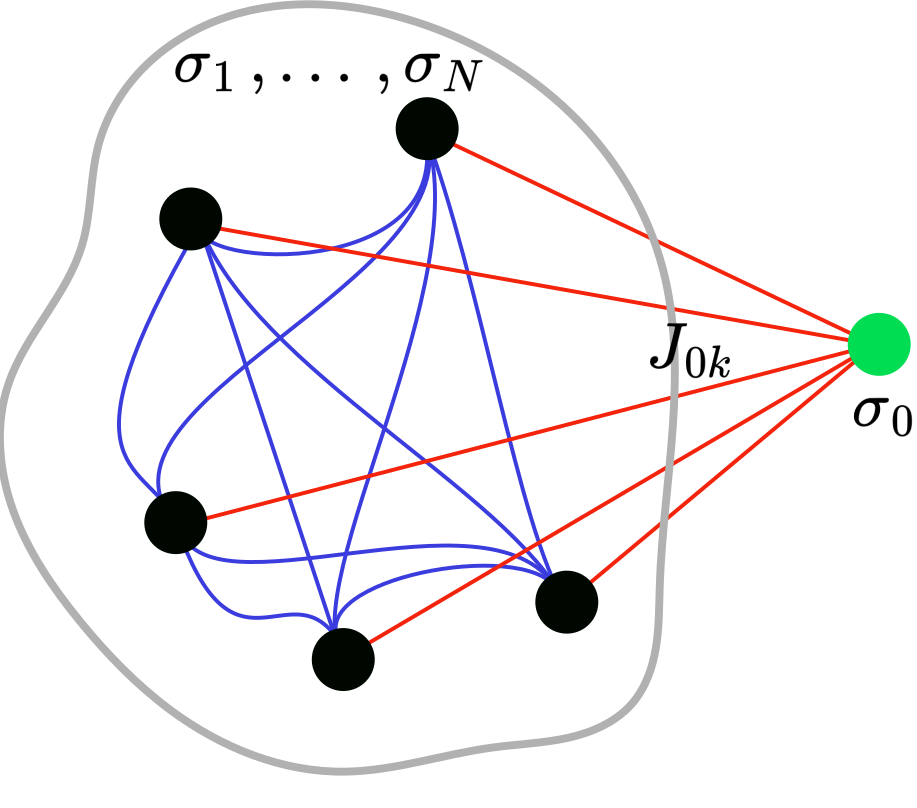
Start from an equilibrated system of N spins σ1,…,σN. Next imagine to add a new spin σ0 and N couplings J0k∼N(0,1), k∈[N] connecting σ0 to σ1,…,σN, see the figure below.
Figure 1: The cavity construction. A new spin σ0 is added to an equilibrated N-spin system and connected to the old spins through new independent couplings J0k.
For the moment I ignore a subleading normalization issue in the couplings, and write the (N+1)-spin Hamiltonian as
HN+1(σ,σ0)=HN(σ)−σ0h0(σ),
where
h0cav(σ)=N1k=1∑NJ0kσk
is the instantaneous cavity field acting on the new spin. The superscript cav stresses that this field is measured in the system where the new spin is still absent. Note also that the couplings J0k are random variables, independent of the old system.
Using (5), the partition function of the N+1 spin system can be written as
Here ⟨∙⟩N denotes the Gibbs average in the original N-spin system. Therefore the free-energy shift produced by the new spin is
ΔF=FN+1−FN=−β1log⟨2cosh(βh0cav(σ))⟩N.
This equation is exact for the cavity Hamiltonian. The problem has now been reduced to understanding the distribution of the random field h0cav(σ) under the Gibbs measure of the old N spin system :
By definition, the cavity field distribution depends on the properties of the Gibbs measure of the N spin system. Let us imagine the general situation in which the Gibbs measure decomposes into pure states α,
ZN=α∑Zα,N,Zα,N=e−βFα,N.
We now condition the Gibbs measure on one such state. Inside state α, before adding σ0, define the cavity magnetizations
mk→0α=⟨σk⟩α,N∖0,
and the self-overlap
qα=N1k=1∑N(mk→0α)2.
When N is large, by the central limit theorem we should expect that the cavity field distribution is Gaussian. We therefore need to compute the first moment and the variance of the cavity field conditioned to state α. The mean value of the cavity field in state α is
u0α≡⟨h0cav(σ)⟩α,N∖0=N1k=1∑NJ0kmk→0α.
I will call u0α the mean cavity field, or cavity bias. This is the field to which the new spin responds once the old system is conditioned on the state α.
Remind that, inside a pure state, connected correlations satisfy the clustering property, that is
N→∞limN21i,j∑⟨(σi−miα)(σj−mjα)⟩α,N2=0.
Using this property, we can compute the variance of the cavity field inside the state
having denoted by Dz a standard normal Gaussian measure
Dz≡2πe−z2/2dz.
The first term in (18) is entropic: even inside a state the cavity field still fluctuates around its state-dependent mean. The second term is the ordinary two-state contribution of the added spin in the effective mean cavity field u0α.
It is useful to distinguish this cavity field from the local field felt by σ0 in the (N+1)-spin system at equilibrium. Before adding σ0, the field distribution in state α is Gaussian as in (16). After adding σ0, configurations are reweighted by eβhσ0. Therefore the joint distribution of the field value h and the spin σ0 in the enlarged system is
After summing over σ0, we obtain the local-field distribution
Pαloc(h)=Zα1Pαcav(h)2cosh(βh).
Notice that the local field distribution is not Gaussian! Indeed, the local field is correlated with σ0: when σ0 is added, it influences the spins σ1,…,σN, which in turn modify the field felt by σ0 itself. This feedback is called the Onsager reaction, discussed in the next section.
By contrast, the cavity field is measured in the system where the new spin is absent.
Thus the magnetization is determined by the mean cavity field u0α, not by the average local field in the equilibrated (N+1)-spin system.
Let us now define this average local field explicitly. In the full system, the old spins have been slightly polarized by the addition of σ0. Hence
H0α≡N1k=1∑NJ0kmkα,
where now
mkα=⟨σk⟩α,N+1
denotes the magnetization in the enlarged system. This is not the same object as u0α, because u0α uses the cavity magnetizations mk→0α of the system in which spin 0 is absent. Using the tilted distribution (20), the average local field can also be written as
called the Onsager reaction term. It corrects naive mean-field theory by accounting for the effect of spin i back on itself through the rest of the system.
Replica symmetry corresponds, in this cavity language, to the assumption that there is only one relevant thermodynamic state. We can then drop the label α from the local magnetizations.
The cavity bias becomes
u0=N1k=1∑NJ0kmk→0.
For fixed cavity magnetizations mk→0, this quantity fluctuates only because of the new couplings J0k. By the central limit theorem,
u0∼N(0,q),q=N1k=1∑Nmk→02.
This statement concerns the mean cavity field u0, not the instantaneous cavity field h0cav(σ). Inside the state, we remind the latter has the distribution
h0cav(σ)=u0+1−qz.
We can now derive a self-consistent equation for the overlap. Since the new spin must be statistically equivalent to the old ones in the thermodynamic limit, its squared magnetization must reproduce the overlap q. Using (23),
m0=tanh(βu0),
and averaging over the Gaussian cavity bias u0=qz gives
q=∫Dztanh2(βqz).
This is the RS self-consistency equation for the overlap that can be also obtained through the replica method.
There is one final technical point to discuss. This will in turn allow us to connect the free-energy shift to the free energy of the model.
In the true SK Hamiltonian (1) with N+1 spins, all couplings should be normalized by 1/N+1, while in the cavity construction above they were normalized by 1/N. This difference can be absorbed by evaluating the (N+1)-spin partition function at the slightly rescaled inverse temperature. The free energy shift we have computed is therefore equal to
Taking the average over the couplings this gives the identity
ΔF=f+21∂β∂(βf)=2β21∂β∂[β3f(β)].
which connects the average free energy shift to the free energy f(β). We can now average the state free-energy shift over the Gaussian field h=qz:
ΔF=−2β(1−q)−β1∫Dzlog2cosh(βqz).
Combining (38) and (39) yields a differential equation for the RS free energy. With the high-temperature boundary condition βf(β)→−log2 as β→0, its solution is
fRS(β,q)=−4β(1−q)2−β1∫Dzlog2cosh(βqz).
Note that the condition ∂fRS/∂q=0 gives exactly (36). This means that the self-consistent equation for the overlap q extremises f(β):
This is the same free energy and equation for q obtained from the replica computation under the RS ansatz. The cavity derivation makes its meaning rather transparent: q is the typical squared magnetization inside a single thermodynamic state, and qz is the state-dependent part of the field felt by a new spin.
At high temperature the only solution is q=0, and (40) reduces to
fRS(β,0)=−βlog2−4β.
At low temperature a non-zero solution appears. This RS low-temperature saddle is not the full solution of the SK model: below the spin-glass transition the correct equilibrium measure requires replica-symmetry breaking. Still, the single-state cavity computation is the cleanest way of seeing where the RS equations come from and what their order parameter means.
References
[1] Sherrington, D. and Kirkpatrick, S., "Solvable model of a spin-glass", Physical Review Letters 35.26 (1975): 1792.
[2] Mezard, M., Parisi, G. and Virasoro, M. A., "Spin Glass Theory and Beyond", World Scientific (1987).
[3] M. Mézard, G. Parisi and M. A. Virasoro, EPL 1 77 (1986)
[4] D. J. Thouless, P. W. Anderson, and R. G. Palmer, “Solution of ‘Solvable model of a spin glass’,” Philosophical Magazine, 35(3), 593–601 (1977)